
Overview
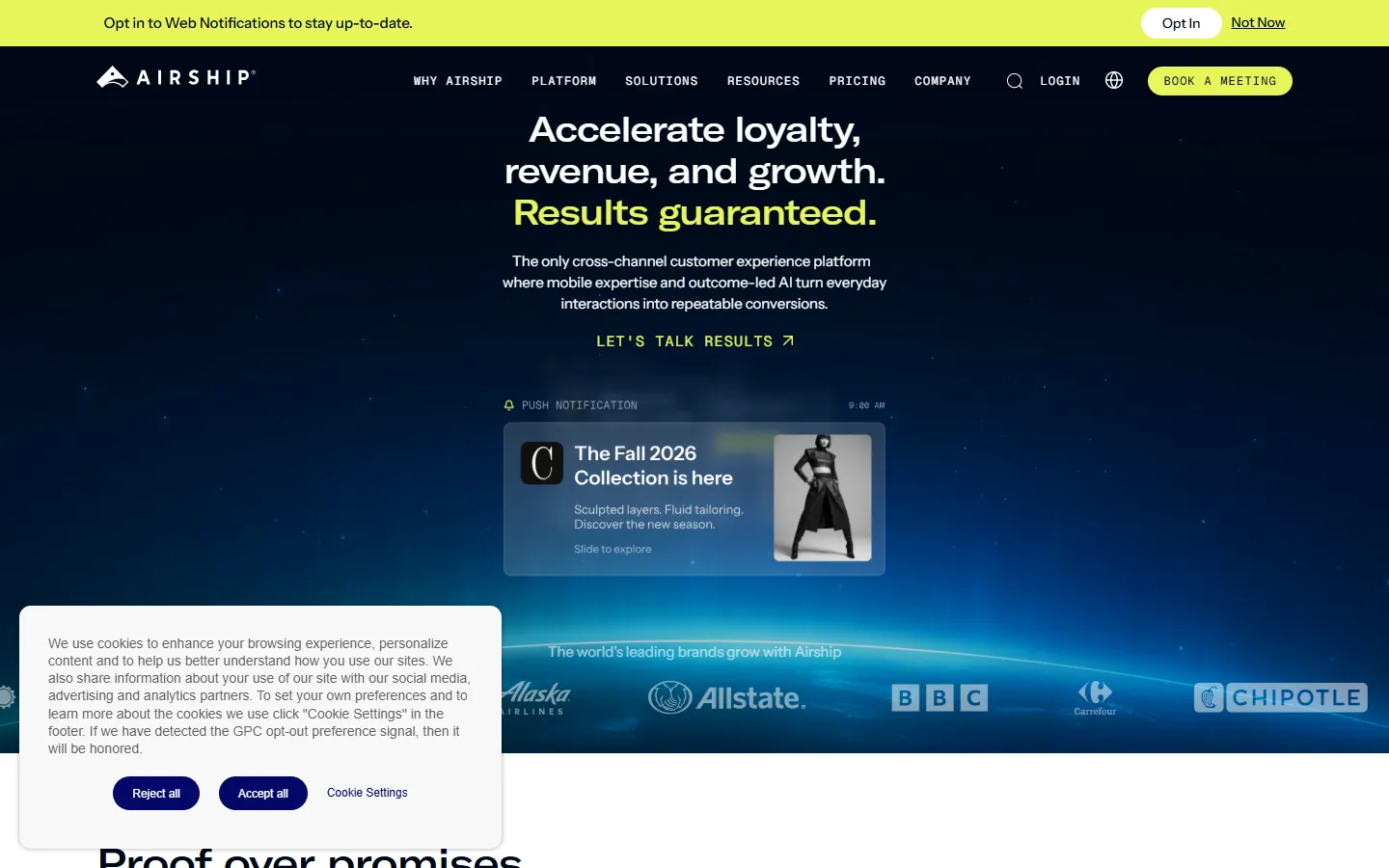
Airship is a mobile-first customer experience platform designed for enterprise B2C brands in retail, media, finance, travel, and telecommunications. It enables marketing and product teams to create, orchestrate, and optimize cross-channel customer journeys across mobile app, web, push notifications, SMS, email, and mobile wallet passes.
The platform incorporates outcome-led AI agents that assist teams with experience generation and optimization. Features like Scenes AI create native in-app screens from text prompts, while automated optimization tools evaluate multi-variant performance in real time to shift traffic toward higher-converting options.
Airship integrates with existing customer data platforms, CRMs, cloud data warehouses, and analytics systems. It offers real-time bi-directional data flows, zero-copy data sharing with platforms like Databricks, and compliance tools supporting GDPR, CCPA, and SOC 2 Type II standards.
Key features
- Cross-channel orchestration: Build goal-based multi-step journeys across mobile app, web, email, SMS, RCS, and wallet passes.
- Scenes AI Agent: Generate native on-brand in-app screens, survey layouts, copy, and branching logic without coding or developer queues.
- Real-time optimization: Automatically route user traffic toward top-performing messaging variants based on live conversion data.
- Recommendation AI: Identify user churn risks and behavior shifts to recommend target audiences and key next actions.
- Enterprise data integration: Connect directly to CDPs, CRMs, and data warehouses, including zero-copy integration with Databricks.
- Accessibility AI: Audit designs for visual contrast, missing alt text, and heading structures with guided one-click fixes.
Pros and cons
Pros
- Direct no-code native in-app experience creation without relying on custom HTML or developer pipelines.
- Multi-channel support spanning push notifications, SMS, RCS, email, web, and mobile wallet passes.
- Bi-directional data synchronization and zero-copy integration with enterprise data stacks.
Cons
- Custom pricing requires contacting sales, as public plan costs are not published.
- Setup and implementation can require technical onboarding for deep mobile SDK integrations.
Best for
- Enterprise brands
- Marketing teams
- Product teams