
Overview
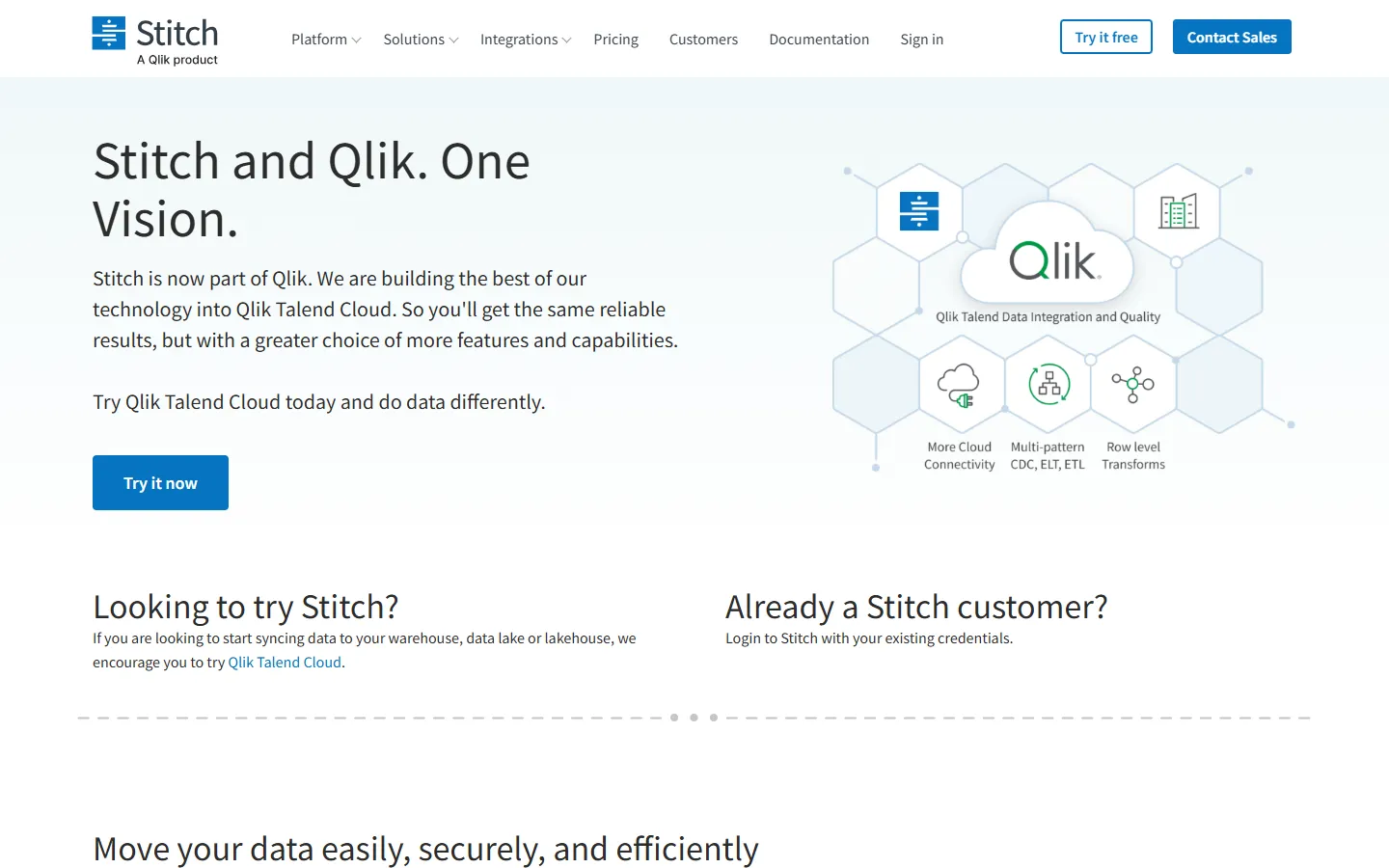
Stitch is a cloud-based ELT platform that automatically ingests data from cloud applications, databases, and files into cloud data warehouses, data lakes, and lakehouses. Designed for data engineers and business analysts, it enables organizations to consolidate operational data without writing or maintaining custom pipeline code. Stitch is part of Qlik and contributes technology to Qlik Talend Cloud.
The platform provides automated pipeline management and selective replication, letting users choose specific tables and fields to sync. Teams can schedule extraction frequencies, configure multiple destinations, and route specific sources to appropriate storage targets. Monitoring features allow administrators to control data flows and track replication performance.
Key features
- Data source connectivity: Syncs data from over 140 SaaS applications, databases, and cloud storage sources into central analytics destinations.
- Selective replication: Allows users to select specific tables and individual fields for extraction to control data storage and ingestion costs.
- Configurable orchestration: Offers flexible scheduling controls, including cron expressions, to run replication tasks from minutes to hours.
- Multi-destination routing: Supports routing distinct data sources to separate data warehouses, data lakes, or storage platforms.
- API and webhook extensibility: Provides a Connect API and post-load webhooks for workflow automation and notification extensibility.
- Security standards: Complies with SOC 2 Type II and ISO 27001 standards with support for private networking options like AWS PrivateLink and VPN.
Pros and cons
Pros
- Connects to a wide selection of databases and SaaS platforms quickly.
- Automates pipeline management and schema updates without custom code.
- Offers selective field replication to avoid ingesting unnecessary data.
- Includes a 14-day free trial with unlimited row syncing.
Cons
- Advanced and Premium plans require annual billing commitments.
- Monthly costs increase significantly as ingested row volume scales.
Best for
- Data engineers
- Business analysts