
Overview
Lexer is an agentic customer data platform (CDP) designed for omnichannel retailers and consumer brands. The platform unifies customer records, point-of-sale transactions, ecommerce activity, loyalty programs, and marketing interactions into a centralized database.
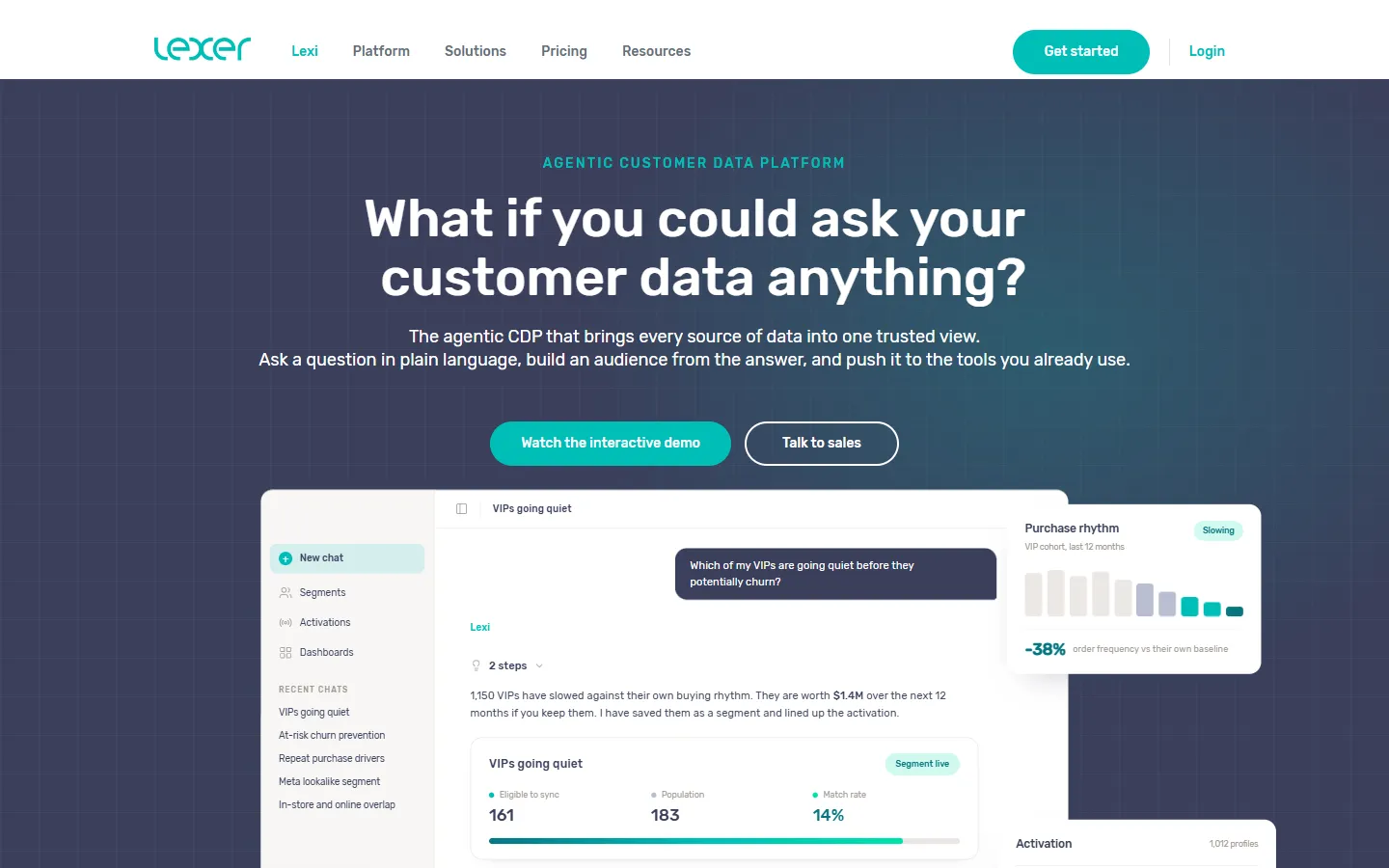
At the center of the platform is Lexi, an AI assistant that allows marketing, CRM, ecommerce, and IT teams to interact with customer data using natural language. Users can query customer behavior, discover opportunities, construct targeted audience segments, and execute marketing campaigns across connected tools from a single conversational interface.
Lexer emphasizes security and data governance by operating within an AWS Bedrock environment. Customer information is governed through role-based access controls, SOC 2 compliance, and audit logs, ensuring personal data is not processed by external third-party models.
Key features
- Conversational AI assistant: Enables users to ask questions, discover behavioral insights, and generate custom segments using plain language prompts.
- Omnichannel identity resolution: Aggregates online purchases, physical store transactions, and engagement data into unified customer profiles.
- Multi-channel audience activation: Pushes generated customer segments directly to channels including Klaviyo, Meta, Google Ads, and TikTok.
- Real-time performance tracking: Monitors campaign metrics against baseline benchmarks and updates segmentation rules automatically.
- Governed AI architecture: Operates in AWS Bedrock without sending personally identifiable information to external model providers.
- Turnkey platform connectors: Integrates with over 700 retail, ecommerce, point-of-sale, and marketing platforms.
Pros and cons
Pros
- Allows non-technical staff to execute complex data queries and segment builds independently.
- Includes unlimited user access across all teams with no seat-based pricing charges.
- Unifies online and offline store transaction histories into one single record.
Cons
- Requires initial integration and mapping setup across existing tech stack data sources.
- Primarily designed for consumer retail and ecommerce workflows rather than B2B applications.
Best for
- Ecommerce brands
- Marketing & CRM teams
- Data teams