
Overview
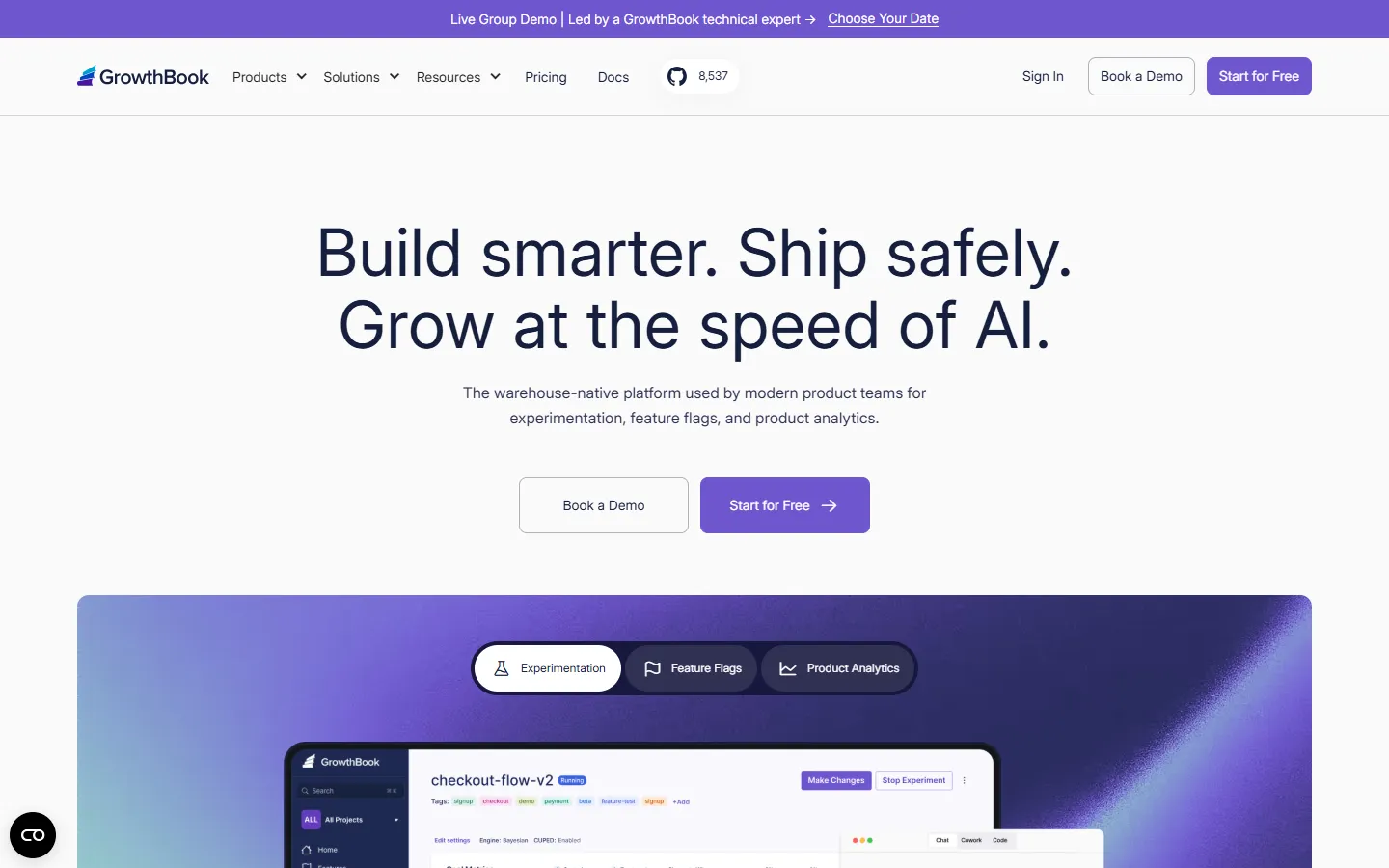
GrowthBook is an open-source, warehouse-native experimentation, feature flag, and product analytics platform built for product, data, and engineering teams. It connects directly to existing data warehouses or lakes, enabling organizations to run A/B tests and analyze user behavior without duplicating data or tooling.
The platform allows teams to deploy low-latency feature flags across client, server, mobile, and edge environments with SDK support for over 24 frameworks. It combines feature targeting and automated rollbacks with statistical models including Bayesian, Frequentist, and sequential testing.
GrowthBook provides AI-native development workflows, allowing AI coding assistants and agents to manage flags, run experiments, and inspect analytics via a dedicated MCP server or REST API. Deployment options include a cloud-managed service and self-hosted open-source instances for privacy-first operating requirements.
Key features
- Warehouse-native analytics: Connects directly to data warehouses such as Snowflake to query product analytics and experiment metrics without data ingestion.
- Feature flag management: Evaluates flags locally with support for percentage rollouts, instant kill switches, scheduled releases, and automated rollbacks.
- Advanced statistical models: Offers Bayesian and Frequentist analysis, sequential testing, CUPED variance reduction, and contextual bandits.
- SDK ecosystem: Supports over 24 SDKs across front-end, back-end, mobile, edge environments, and OpenFeature standards.
- AI & MCP integration: Connects to AI agents and coding tools via Model Context Protocol (MCP) server and agent skills to automate flag creation and cleanup.
- Visual editor & product analytics: Includes an AI visual editor for web experiments alongside funnel metrics, user journeys, and SQL exploration.
Pros and cons
Pros
- Direct warehouse connection eliminates duplicate data storage and vendor data lock-in.
- Full open-source core with self-hosting options for privacy and compliance.
- Supports both human developers and AI coding agents via native MCP server integrations.
Cons
- Self-hosting requires internal maintenance and infrastructure setup.
- Advanced capabilities like multi-arm bandits and approval workflows are restricted to higher tiers.
Integrates with AI
Connect GrowthBook to AI assistants and agents.
- MCP server(opens in a new tab)
- Claude(opens in a new tab)
- Codex(opens in a new tab)
- Cursor(opens in a new tab)
Compare: Marketing tools with an MCP server · Marketing tools that integrate with Claude · Marketing tools that integrate with Codex · Marketing tools that integrate with Cursor
Best for
- Product teams
- Data science teams
- Engineering teams