
Overview
Databricks is a unified data, analytics, and AI platform built on an open lakehouse architecture. Designed for enterprise engineering, data science, and business analytics teams, it combines transactional processing, data warehousing, and machine learning into a single managed environment across major cloud providers.
The platform eliminates the need to maintain separate data lakes and data warehouses by unifying data pipelines, governance, and operational workloads. Users can ingest, store, transform, and analyze structured and unstructured data using open standards like Delta Lake, while building custom AI agents and operational applications directly on their enterprise data.
Key features
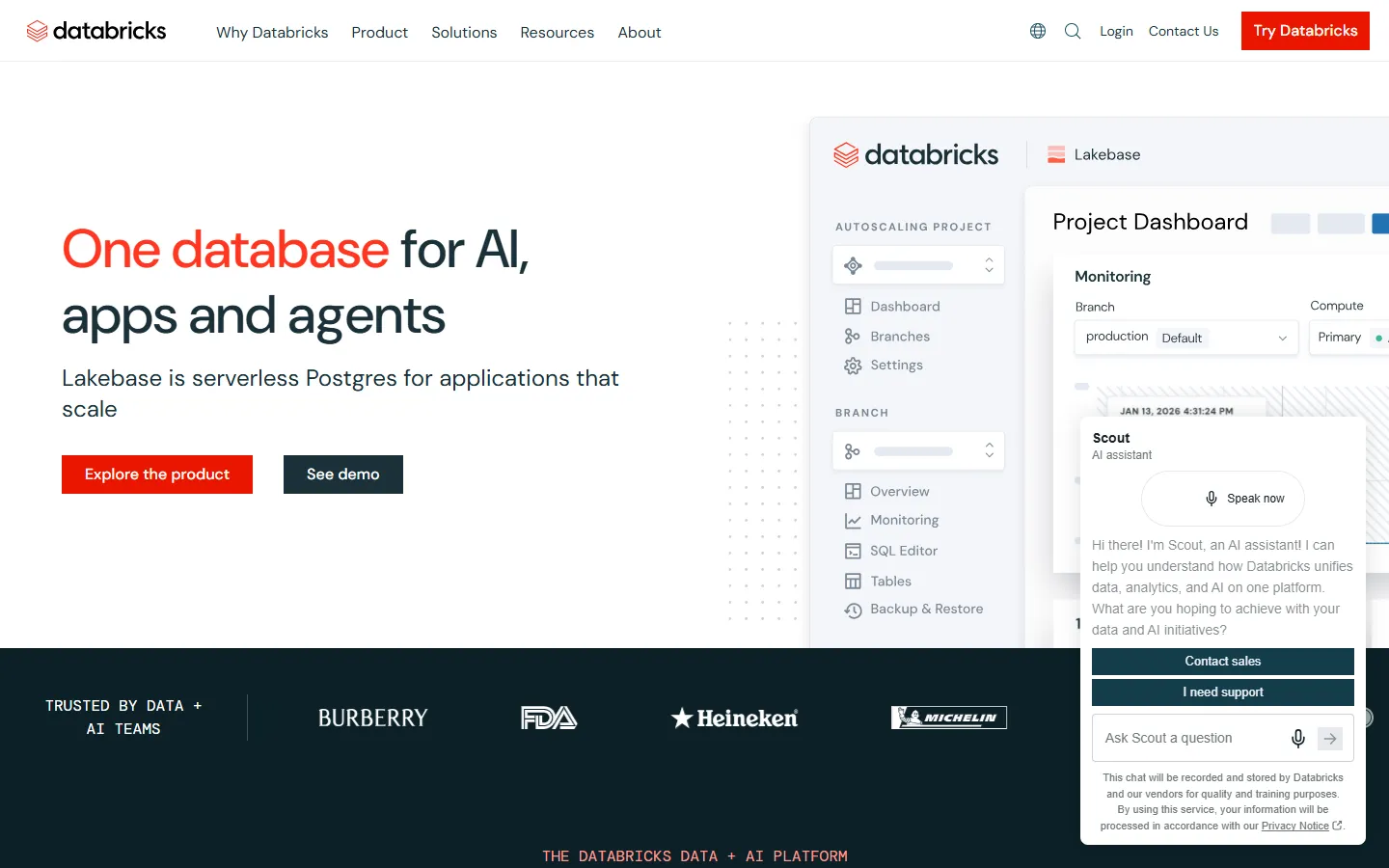
- Lakebase serverless Postgres: Provides a transactional database integrated with the lakehouse that automatically scales compute and syncs operational data without custom ETL pipelines.
- Unity Catalog: Delivers centralized governance, access control, observability, and auditability across multicloud data assets, models, and AI agents.
- Databricks Genie: Offers a natural language conversational interface that enables business users to query data and generate visualizations without writing SQL.
- Lakeflow: Enables teams to build, transform, and orchestrate batch and streaming ETL data pipelines at scale.
- Agent Bricks: Provides a framework to build, evaluate, and deploy domain-specific AI agents grounded in enterprise data.
- Databricks Apps: Allows developers to build and host secure data and AI applications using popular Python frameworks and serverless compute.
Pros and cons
Pros
- Unifies operational databases, data warehousing, and AI workloads on a single governed platform.
- Eliminates custom ETL maintenance by automatically syncing transactional data from Lakebase to analytics layers.
- Supports native multicloud deployment across AWS and Azure with unified Unity Catalog governance.
Cons
- Cloud provider resource usage incurs separate infrastructure charges outside of Databricks billing.
- Broad platform scope presents a steep learning curve for non-technical users or smaller data teams.
Integrates with AI
Connect Databricks to AI assistants and agents.
Best for
- Enterprise data teams
- Business analysts
- AI developers